
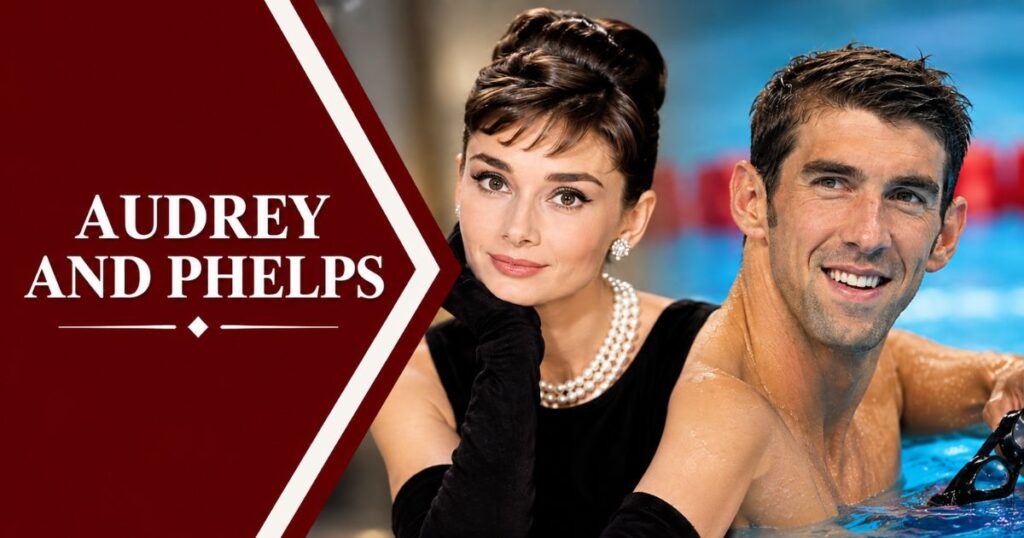
Audrey Hepburn and Michael Phelps built their legacies in completely different arenas, one on the silver screen and one in the Olympic pool, yet both became symbols of excellence that stretch far beyond their original fields. Hepburn turned grace, style, and humanitarian devotion into a lasting Hollywood legacy. Phelps redefined what a single athlete could achieve in a swimming pool, then used that platform to change how the world talks about mental health.
This article breaks down who they were, how they rose to fame, what their family lives looked like, and what these two very different icons actually have in common. A quick bio table up top gives you the essential facts before we go deeper into each life story.
Who Were Audrey Hepburn and Michael Phelps?
Audrey Hepburn was a British actress and humanitarian best remembered for her role in Breakfast at Tiffany’s, her Academy Award winning performance in Roman Holiday, and decades of work as a UNICEF Goodwill Ambassador. Michael Phelps is an American former competitive swimmer widely regarded as the most decorated Olympian in history, with 28 Olympic medals to his name.
One built a legacy in classic Hollywood cinema. The other built one in the swimming pool. Both became cultural touchstones whose influence reaches well beyond their original professions, shaping fashion, sport, philanthropy, and public conversations about mental wellbeing.
Audrey Hepburn and Michael Phelps Quick Bio Table
Here is a side by side snapshot of both icons before we explore their full stories.
| Category | Audrey Hepburn | Michael Phelps |
| Full Name | Audrey Kathleen Hepburn-Ruston | Michael Fred Phelps II |
| Born | May 4, 1929, Ixelles, Belgium | June 30, 1985, Baltimore, Maryland, USA |
| Died | January 20, 1993 (age 63) | Living |
| Profession | Actress, humanitarian | Retired competitive swimmer |
| Best Known For | Roman Holiday, Breakfast at Tiffany’s, My Fair Lady | 28 Olympic medals, 23 of them gold |
| Height | 5 ft 7 in (170 cm) | 6 ft 4 in (193 cm) |
| Spouse(s) | Mel Ferrer, Andrea Dotti | Nicole Johnson |
| Children | 2 sons | 4 sons |
| Signature Honor | Academy Award, Presidential Medal of Freedom | Most decorated Olympian in history |
| Estimated Net Worth | Undisclosed Hollywood era earnings | Around $100 million (2026 estimate) |
Audrey Hepburn: Early Life and Background
Audrey Hepburn was born Audrey Kathleen Ruston on May 4, 1929, in Ixelles, a district of Brussels, Belgium. Her father, Joseph Ruston, was a British born businessman, and her mother, Ella van Heemstra, was a Dutch baroness. Hepburn spent much of her childhood between England and the Netherlands, training as a ballet dancer from an early age.
When World War II broke out, Hepburn and her mother were living in Arnhem, Netherlands, under Nazi occupation. The family endured severe food shortages during the final winter of the war, and Hepburn later credited relief supplies from the United Nations with helping her survive that period, an experience that quietly shaped the rest of her life.
How Did Audrey Hepburn Become Famous?
Audrey Hepburn became famous after French novelist Colette handpicked her to star in the Broadway adaptation of Gigi in 1951, a role that led directly to her breakout film part in Roman Holiday two years later.
That 1953 performance opposite Gregory Peck earned her the Academy Award for Best Actress in her very first major film role, an extraordinary achievement for a newcomer. She followed it with a run of classics that are still studied and celebrated today, including:
- Sabrina (1954)
- Funny Face (1957)
- The Nun’s Story (1959)
- Breakfast at Tiffany’s (1961)
- Charade (1963)
- My Fair Lady (1964)
The American Film Institute later ranked her as the third greatest female screen legend in Hollywood history, a title that still holds strong decades later.
Audrey Hepburn’s Family and Personal Life
Audrey Hepburn married actor and director Mel Ferrer in 1954. The couple had one son, Sean Hepburn Ferrer, before divorcing in 1968. She then married Italian psychiatrist Andrea Dotti in 1969, and the pair had a second son, Luca Dotti, before that marriage ended in 1982.
In her final years, Hepburn shared her life with Dutch actor Robert Wolders, her companion from 1980 until her death in 1993. Family remained central to her throughout her life. She scaled back her acting career significantly after the late 1960s to focus on raising her sons, returning to the screen only occasionally during the 1970s and 1980s.
What Did Audrey Hepburn Do for UNICEF?
Audrey Hepburn served as a UNICEF Goodwill Ambassador from 1988 until her death in 1993, using her global fame to draw attention to child hunger, poverty, and the effects of war.
Her first field mission took her to Ethiopia in 1988, where drought and civil conflict had triggered a devastating famine. Over the next several years she traveled to Sudan, Somalia, Bangladesh, Vietnam, Kenya, Turkey, Guatemala, Honduras, and Venezuela, visiting refugee camps, feeding centers, and vaccination programs. She often gave more than a dozen media interviews a day just to keep the world’s attention on children’s needs.
Hepburn testified before a United States congressional subcommittee on hunger in 1989, and again in 1991 to push for greater humanitarian aid to Africa. In December 1992, only weeks before she died, she received the Presidential Medal of Freedom in recognition of this work, one of America’s highest civilian honors.
How Did Audrey Hepburn Die?
Audrey Hepburn died on January 20, 1993, at age 63, after being diagnosed with a rare form of appendiceal cancer called pseudomyxoma peritonei.
She began experiencing abdominal pain shortly after returning from a UNICEF mission to Somalia in 1992. Doctors in Los Angeles discovered the cancer during exploratory surgery that November, and although she underwent treatment, the disease had already spread. Hepburn chose to spend her final Christmas at her home in Tolochenaz, Switzerland, surrounded by her sons and Robert Wolders, and passed away peacefully in her sleep the following January.
Read More: Selena Gomez and Jeff Greene: The Real Story Behind the Search
Michael Phelps: Early Life and Background
Michael Fred Phelps II was born on June 30, 1985, in Baltimore, Maryland. He started swimming at age seven, partly to burn off excess energy after being diagnosed with attention deficit hyperactivity disorder around age nine or ten. His older sisters, Hilary and Whitney, were already competitive swimmers, and their example pulled him toward the sport early.
He joined the North Baltimore Aquatic Club, where coach Bob Bowman spotted his raw talent and began building the demanding training program that would eventually turn him into the most successful Olympian in history.
How Did Michael Phelps Become the Greatest Olympian Ever?
Michael Phelps became the greatest Olympian ever by winning 28 Olympic medals across five Games, including a record 23 gold medals, more than any athlete in any sport in Olympic history.
His medal count grew steadily with every Olympics he entered:
- Sydney 2000: Qualified at age 15, becoming the youngest male swimmer on a U.S. Olympic team in 68 years.
- Athens 2004: Won six gold medals and two bronze medals.
- Beijing 2008: Won a record eight gold medals in a single Games, breaking Mark Spitz’s long standing record.
- London 2012: Added four gold medals and two silver medals.
- Rio 2016: Closed his career with five more gold medals and one silver.
Across those five Olympics, Phelps also set numerous individual and relay world records in events such as the 200m butterfly, the 400m individual medley, and the 4x100m medley relay, records that shaped how competitive swimming is trained and coached today.
Michael Phelps’s Family Life
Michael Phelps married Nicole Johnson, a former Miss California USA, in June 2016. The couple has four sons together: Boomer, born in 2016 shortly before their wedding; Beckett, born in 2018; Maverick, born in 2019; and Nico, born in January 2025.
The family lives in Arizona, where Phelps has settled since retiring from competitive swimming. He has spoken openly about how fatherhood reshaped his priorities, describing parenting as one of the biggest reasons he stays focused on both physical and mental wellbeing, not just for himself but as an example for his sons.
Why Is Michael Phelps a Mental Health Advocate?
Michael Phelps became a mental health advocate after privately struggling with depression, anxiety, and dark thoughts following several of his Olympic Games, particularly after the 2012 and 2016 competitions.
He has spoken publicly about entering treatment in 2014, following a second DUI arrest, a turning point that pushed him to finally address feelings he had hidden for years. Since then, Phelps has partnered with mental health organizations, spoken at conferences including the Kennedy Forum, and worked with online therapy platforms to encourage open conversations, especially among male athletes who often feel pressure to appear invulnerable. Through the Michael Phelps Foundation, he also supports water safety and healthy living programs for young people, while his personal advocacy has helped normalize therapy and mental health check ins across professional sports.
How Much Is Michael Phelps Worth?
Michael Phelps has an estimated net worth of around $100 million as of 2026, built mainly through endorsement deals, appearance fees, and business ventures rather than swimming prize money alone.
Olympic swimming itself pays relatively little in direct prize money, but Phelps earned an estimated $10 million or more annually through sponsorships with major brands during his competitive peak. After retiring, he co-founded a swimwear and pool technology venture with longtime coach Bob Bowman, and he continues to earn through public speaking, media work, and his ongoing mental health advocacy partnerships.
Read More: Dilip Shanghvi and Jensen Huang: Biography, Net Worth And Career
Audrey Hepburn and Michael Phelps: What Do They Actually Have in Common?
At first glance, a twentieth century film icon and a twenty first century swimming champion seem to have little in common. Look closer, though, and several genuine parallels appear.
- Icon status in their field: Hepburn is consistently ranked among cinema’s greatest screen legends, and Phelps is the most decorated Olympian of all time. Both sit at the very top of their professions.
- Struggle turned into purpose: Hepburn survived wartime malnutrition as a child and later devoted years of her life to feeding hungry children through UNICEF. Phelps battled depression privately for years and later devoted his public platform to mental health advocacy.
- Global humanitarian reach: Hepburn traveled to some of the world’s poorest and most conflict affected regions for UNICEF, while the Michael Phelps Foundation supports water safety and healthy living programs for children around the world.
- Family centered later life: Both scaled back their most demanding career commitments to prioritize raising their children once they had already reached the top of their fields.
- Enduring public influence: Decades after their peak fame, both remain constant reference points in fashion, sport, documentaries, and popular culture.
These similarities suggest that lasting icon status rarely comes from talent alone. It comes from how a person uses their platform once the spotlight is already shining on them.
Conclusion
Audrey Hepburn and Michael Phelps represent two very different chapters of American cultural history: one defined by Hollywood’s golden age and international humanitarian work, the other by unmatched Olympic dominance and honesty about mental health. Hepburn’s journey from a malnourished child in wartime Europe to one of cinema’s most beloved stars and UNICEF’s most devoted ambassador remains a powerful example of turning hardship into purpose.
Phelps’s rise from a hyperactive kid in a Baltimore pool to the most decorated Olympian in history, followed by his candid public battle with depression, follows a similar arc of struggle and transformation. Neither icon is remembered only for their headline achievements. Both are remembered for what they did with the platform those achievements gave them.

I’m David , founder of Msg Word, where emotions turn into meaningful words. Combining creativity with SEO expertise, I craft heartfelt messages that connect, inspire, and spread positivity for every occasion.